
Vera Brittain’s Buxton
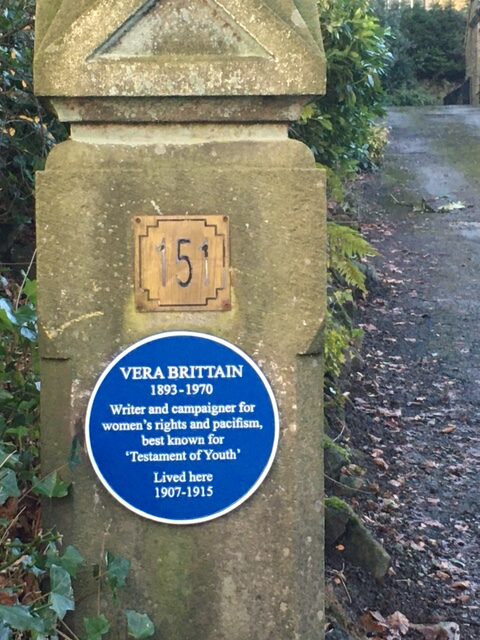
The town of Buxton, nestling as it does, in a bowl in the Pennines can feel an isolated place. It certainly felt that way to Vera Brittain ,the author of Testament of Youth, who lived in the town and referred to it as a place of censorious small mindedness. Vera worked as a VAD at the Devonshire Royal hospital in Buxton before leaving to nurse in France during the First World War.
Her experiences of war had a lasting impact on her. Her brother, fiancee and her best friend were all killed. In St John’s church Buxton there is a plaque on the north wall to commemorate Lt Jerry Knowles GARNETT, Royal Field Artillery, 3rd East Lancs Brigade, who died, in Hospital on Malta, on the 6th November 1915, aged 20.
In her book, “Testament Of Youth Vera Brittain describes visiting his grave and sending a flower back to his parents. Jerry Garnett was a close friend of Vera’s brother, Captain Edward Brittain who was also killed. Vera, was haunted by her brother’s death for the rest of her days and her ashes were taken to Italy by her daughter, later Baroness Shirley Williams, and sprinkled on Edward’s grave.
The impact of the first world war on places like Buxton was measurably real. The loss of manpower made it impossible for many businesses to continue when peace returned and a steep economic decline followed. It never fully recovered from the devastation of 1916 and its pre-war posterity never returned.
It explains one of the reasons why one in 7 residents of the town around the time of the First World War and certainly until the outbreak of the Second World War were in domestic service!
Oliver Gomersall one of the older residents of the town, tells the tale that in the early 1930s there were three countesses living in the town. Our reputation and attraction amongst the wealthy Victorian and Edwardian middle classes was based on our spa waters. ‘One would think the English were ducks, they are for ever waddling to the waters’, said Horace Walpole in 1790. Waddle was a good word for the movement of upper class society, both awheel and afoot in the heyday of spas.
Meanwhile in the arc of quarries surrounding Tunstead, we had Perseverance, Smalldale, Duchy, Long Sidings, Southworks and Buxton Central here men still worked loading stone by hand. These men did not waddle; these men were lean and wiry working long hard hours in dangerous conditions.
Prior to the first world war, in 1905, a large proportion of the Devonshire estate was transferred to the Buxton Corporation and times were changing whatever your class. Fairfield ,still separate from Buxton, had it’s own urban district council and a population of approx 4,000 but by 1917 it had joined forces with Buxton becoming Buxton borough council and taking the population to 17,000.