
James, one of Micah’s brothers, became a master builder and owned the local firm which was selected to build The Town Hall in Buxton, at a tender of £8,900! He also built the Entertainment Stage or old Hippodrome Theatre which now houses the Buxton Cinema.
Interestingly, and perhaps as an homage to Hollinsclough, he built both Hollins Street and Clough Street in Buxton and in Hollinsclough chapel are two stained glass windows paid for by James in 1902.
So what did Micah an “intelligent tradesperson, as one author described him, discover?
This area, and Buxton particularly, has a very rich history going back to the earliest historic times. There are numerous ancient burial mounds, known as barrows in the area. From the top of Solomon’s Temple on Grin Low in Buxton are at least 20 barrows which can be seen on the tops of the neighbouring hills. The word low means burial mound, Grin Low, Fairfield Low, Thirkel Low, were all excavated by Micah, along with the delightfully named Gospel Hillock near King Sterndale. Micah and his sons excavated Grin Low on numerous occasions finding several human skeletons and one of a dog. Flints and vases were also found.
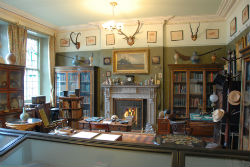
Fairfield Low, known locally as Skellybob Wood, was first opened in 1895 and a skeleton found in an advanced state of decay. About three months later, he returned to the site and found a second adult skeleton and that of a child. The skull of the adult was given to Buxton Museum and sits on the desk in the Boyd Dawkins study. In fact, he donated many of his finds to the museum and they are on display in the museum. You can see the skull sitting on the desk in the picture below. He also donated approximately 180 stuffed birds, perhaps another potential link to the Harpur Crewe family, who also had a huge collection of stuffed birds and were avid collectors. Micah apparently also kept a pet raven!
Not satisfied with excavating barrows he also turned his attention to many of the local caves. In 1884, he made the first of many visits to Thirst House Cave in Deepdale. News of the discoveries he made there reached the press and there was for a period of time a frenzy of activity from a variety of “treasure hunters” as they were frequently called. The man who owned the land threatened trespassers with prosecution and eventually things settled down. The cave though yielded many, many finds. Eventually they contacted Professor Boyd Dawkins of Owen’s College, Manchester who was able to confirm that most of the finds were Romano British. He said of the collection he received, “It is not a little remarkable to hold in ones hands fragments that have been brought from countries and places hundreds, nay ,perhaps thousands of miles apart from one another, and there deposited and used by people many centuries before Christ, and the most recent at least fifteen hundred years before Mr Salt disturbed them from their resting places.” (Journal of the Derbyshire Archaeological and Natural History Society Vol 12 1890)