Vera Brittain at the Devonshire Dome
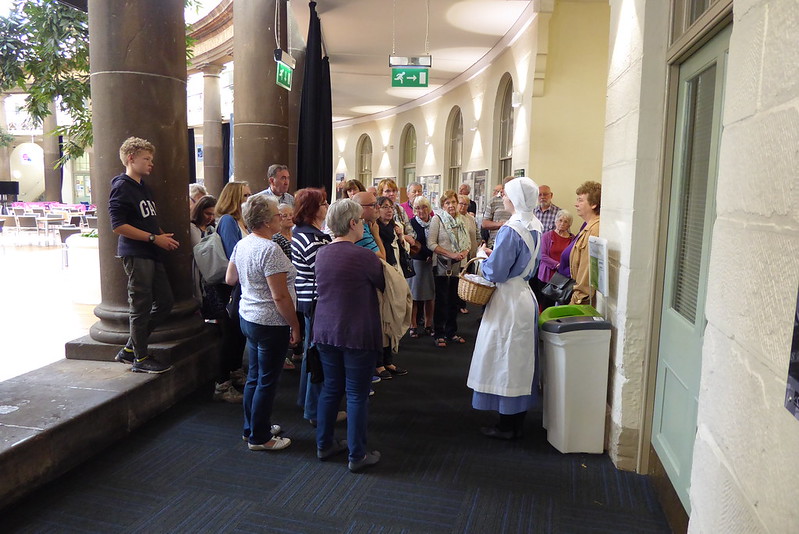
Our Vera Brittain character guide is performing at the Devonshire Dome on Tuesday 26th October at 4pm.
There was a feminist slogan in the 1970’s which said ‘the personal is political’ and if any book embodied a full understanding of that phrase it was Vera Brittain’s testament to her wartime experiences as a young, intelligent, Edwardian woman trapped between the expectations of her gender and class and the expectations of the politics of empire. Her book, Testament of Youth, which took almost 17 years to write, was Vera Brittain‘s testament to personal loss. Her fiancé, brother and two closest male friends were killed in the so-called ‘Great War’. Vera, was haunted by her brother’s death for the rest of her days and her ashes were taken to Italy by her daughter, Baroness Shirley Williams, and sprinkled on Edward’s grave. His grave can be found close to a wall in Granezza British Cemetary in Italy, in the midst of a group of privates from the Sherwood Foresters who had all died on June 15th. He was 22 years of age.
“How strange, how strange it is,” I reflected, as I looked, with an indefinable pain stabbing my chest, for Edward’s name among those neat rows of oblong stones, “that all my past years-the childhood of which I have no one, now, to share the remembrance, the bright fields at Uppingham, the restless months in Buxton, the hopes and ambitions of Oxford, the losses and long-drawn agonies of the War- should be buried in this grave on the top of a mountain, in the lofty silence, the singing unearthly stillness, of these remote forests.”
We are honoured to be able to tell the story of Vera Brittain in the very place she first nursed – the Devonshire Hospital in Buxton, now a campus of the University of Derby.
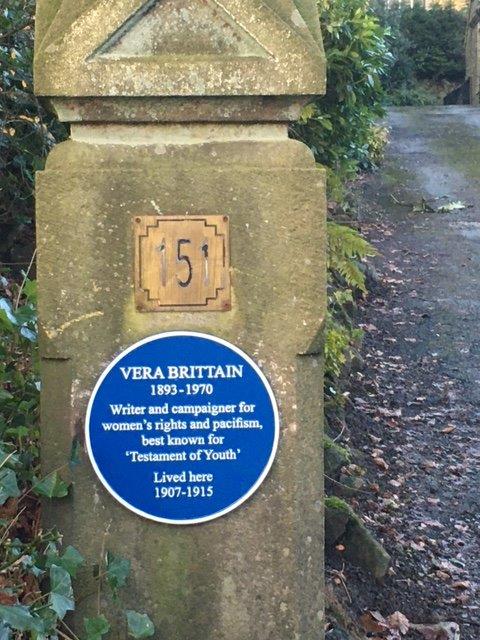
Vera and her middle class, privileged family came to live in Buxton in 1905 when she was 11 years old. They lived first at High Leigh on Manchester Road then moved to Melrose on Park Road where a blue plaque marks the place (pictured below). Vera’s ambitions, however, were far greater than those imposed on Edwardian women and she desired to break free of a town she referred to as full of “censorious small-mindedness”.
Just as the First World War was breaking out, she won an Exhibition to Somerville to read English but, by the end of her first year, she decided it was her duty to leave Oxford and do something for the war effort.
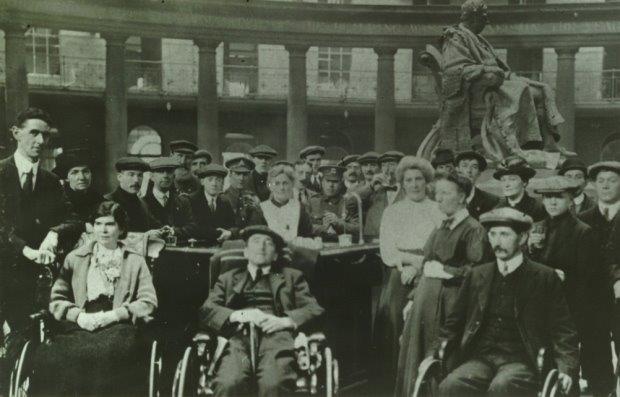
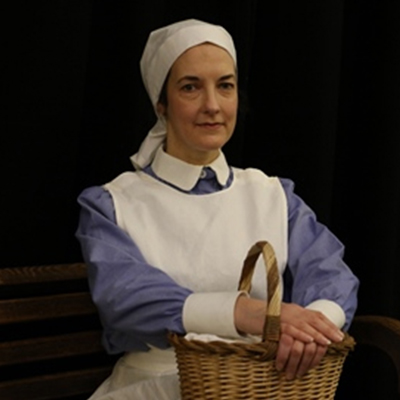
She returned to Buxton during the summer of 1915 to work as a Voluntary Aid Detachment (VAD) nurse (pictured above) tending wounded soldiers at the Devonshire Hospital (pictured above). It is possible she trained here in the town because the Royal Hotel on Spring Gardens, now housing shops such as Track and Trail, became a training centre for VAD’s.
Now, in fairness, the Devonshire Hospital was not a major player during that time. It was mainly a convalescent facility for those with rheumatism and allied diseases such as shell shock, or “low moral fibre” as it was then known. This experience, nursing some of the 5,400 soldiers who were treated here in Buxton, was the start of her coming to terms with the manipulation of minds which sent so many young men to their deaths. In the place where Vera Brittain first formed her testament to a lost youth, we tell a powerful and moving story.
We will be offering this performance at the Devonshire Dome on Tuesday 26th October at 4pm, £15pp. Spaces are limited. Please phone directly to book tickets – call 07530 457755.