

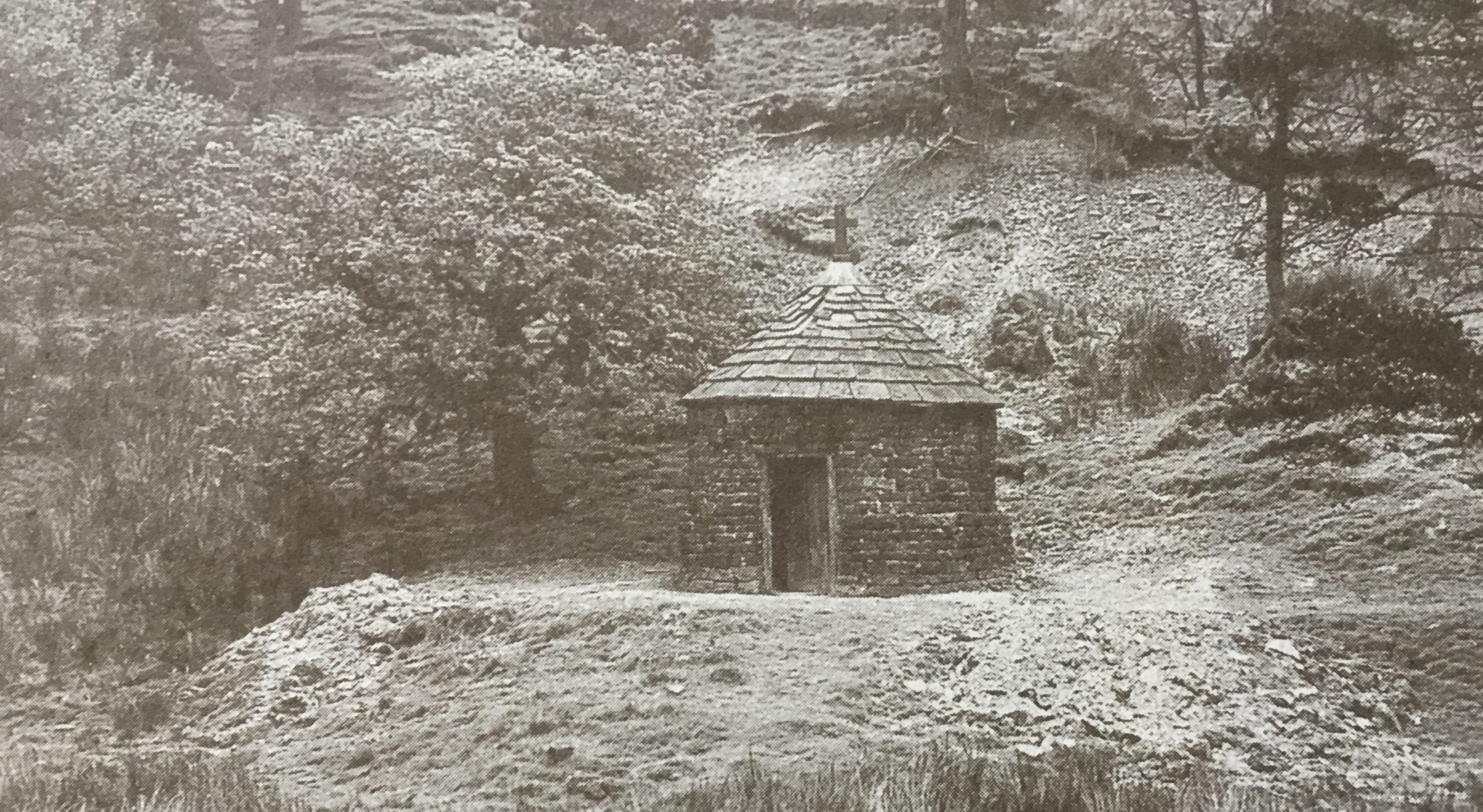
The road down into the Goyt valley from the Long Hill is known as old Goyts Lane. After a few yards just past the cattle grid you will see on the left hand side of the road a Catholic shrine.
It has always been a bit of a mystery to me and I have long thought that I would research more about it. The shrine was commissioned by Canon Baldwin who was priest at the nearby St Ann’s church in Buxton from 1942-1956
https://www.youtube.com/watch?v=ns_rxGOMp8M
Canon Baldwin paid for the original mosaic and the rock was gathered from the nearest stream by its builder, Brian Foxton, who also utilised two disused gateposts. I can only guess that the decision to build the shrine here was to commemorate the Catholic Grimshawe family who used to live in nearby Errwood Hall. Samuel Grimshawe came from a rich merchant family in Manchester and it was his ambition to possess a country seat hence Errwood Hall was built in 1840. Over the years and until the death of the last of the family in the 1920’s the family were great benefactors and local employers. If you do visit this area then also look for St Joseph’s shrine(picture below) to the rear of the old hall. The marvelously named Dolores de Ybarguen, whose initials can be seen in this shrine, came to be a companion to Jessie Grimshawe around 1883.
As this shrine was built within the estate grounds it must not count in the claim that the road side shrine was the first to be built in this area since the reformation of the 1500’s. The reformation was a massive changing point in history.Henry VIII wanted a divorce from Catherine of Aragon so he could remarry but this was refused. Henry therefore declared in 1534 that he alone should be the final authority in matters relating to the English church. Catholicism, literally in some cases, went underground. Here in Buxton the chapel of St Ann was torn down and allegedly the crutches of those who sought a cure from the “holy waters” made into a bonfire and burnt. When Mary Queen of Scots, held prisoner of the English for 19 years, because of her Catholic faith, came to Buxton to take the waters, she would have been careful never to meet Richard Topcliffe, the infamous Elizabethan Catholic torturer, who like her, scratched his name on the window glass of the Old Hall. These really were dangerous times to be Catholic and it was many centuries before people were freely able to practice their faith.
It was not until 1860 that Buxton got its first Roman Catholic Church. St Ann’s stands on Terrace Road in Buxton, built to the design of Henry Currey, architect to the Duke of Devonshire, and is built of stone in the gothic style. Currey was also responsible for Christ Church Burbage, The Palace Hotel and what was known as the Turkish bath in the Quadrant amongst other notable buildings in the town.
It was the Grimshawe family of Errwood Hall who mainly paid for St Ann’s church, with Genevieve Grimshaw attending the opening ceremony. After the ceremony visiting dignitaries retired to Errwood Hall for refreshment.
Prior to the opening of the church Catholic families would gather in local homes with, I understand, mass celebrated by a priest from Leek. Many of the early Catholic worshipers and eventual settlers in the town came from Ireland to work on the Midland railway. This huge undertaking started in 1840 with the branch line from Miller’s Dale eventually reaching Buxton in 1863.It was along this route that the smallest station in Britain was sited at Blackwell Mill Halt ,built to provide transport for the railway cottages with trains stopping here a couple of times a week to enable shopping to be brought back from Buxton. So the next time you pass by this shrine just stop and reflect on all this tiny moorland shrine represents.