
Reflecting on the Contribution of Oliver Gomersal
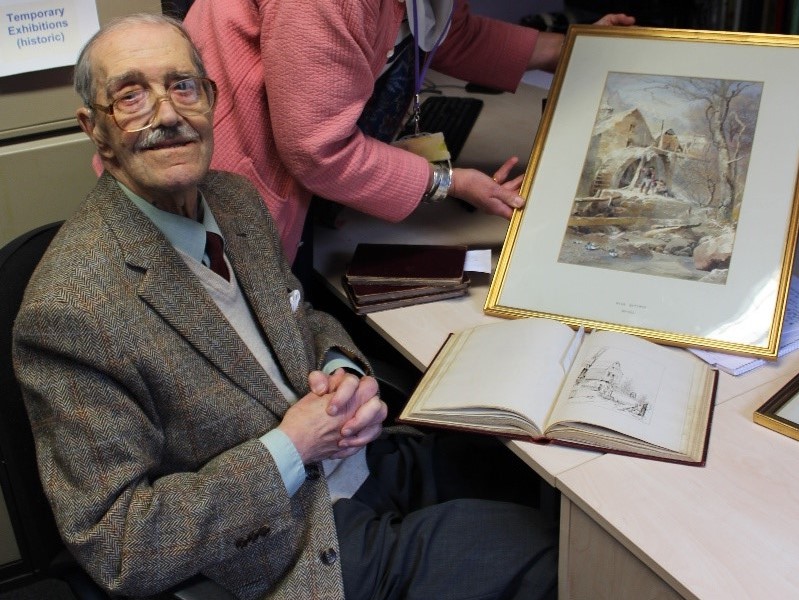
As we enter the New Year, it gives the opportunity to look back on 2022 and particularly to celebrate the life of a local man, Oliver Gomersal (pictured above), who sadly died in October, at the grand old age of 101, and to whom I owe a great deal of thanks. Oliver possessed the most incredible memory and was able to bring the past to life with his wonderful anecdotes. I met him for the first time in 2012 as I was setting up Discover Buxton Tours and regularly went to visit and talk with him about the past. In fact, we regularly mention Oliver on our tours, particularly when talking about the Assembly Room in the Crescent.
It was Oliver, who worked in local government, who told me that when the library was moved out very quickly in July 1991, it was because a local councillor had been told by a geologist that it was built on a fault line and in imminent danger of collapse!!
Who knows the full story? This is what is so wonderful about history; that there are so many ways of looking at the so-called facts and plenty of opportunities to tell the story to the advantage of one group above another. There is certainly no doubt that the Crescent is built on the fault line that runs to Mam Tor, the Shivering Mountain! When the Crescent was built, that is presumably why so many piles were driven into the site before building commenced.
Oliver was born on 21st May 1921 to Arthur, a well-known footballer and cricketer, entertainer and collector of books and paintings. Much of his collection was bequeathed to Buxton Museum & Art Gallery. See the Museum’s blog post about him, in celebration of his 100th birthday here.
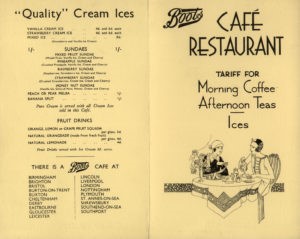
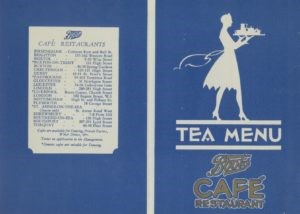
His Mother was Gertrude, a pianist, who, during the first war, played regularly for the soldier patients in the Devonshire Hospital; and also in a trio in the Pump Room during the mornings and in Boots Café in the afternoons. Boots Café seems to have been one of the places to be! See some menus below.
The following is an excerpt from an oral recording of Oliver:
“My mother was a pianist and in the late Edwardian period, probably during the first war, she played in a little trio which played in the Pump Room in the mornings and in Boots Café in the afternoon and it added quite an air if you sat down and had your cup of tea, I’m sure, but she married in 1920 and it wasn’t carried on after the war. Upstairs, Boots, always at Christmas time in my youth, made a special display of things. There was an imposing staircase up to the first floor and this was highly decorated, and it was again one of the bright spots of Christmas in Buxton in the 40’s and 50’s.”
During the Second World War, Oliver became a navigator in the RAF, achieving the rank of Fight lieutenant. On his return to Buxton, he resumed a career in local government. In 1980, he joined the Buxton Archaeological & History Society and gave many papers. One of these was to make a study of the subscribers to the Buxton Ballroom in the Crescent from when it opened in 1788 until its final year in 1840. I have his original handwritten notes and it certainly has been referred to many times and used as a basis for many of our stories about the town and its many visitors.
The contribution he made to the understanding of the town’s history was reflected in the number of local historians and authors who attended his funeral. Oliver’s 101 years of lived experience helped to bring the past alive in a very unique way.
Thank you, Oliver, for your contribution to the town and to our tours. As such, your stories live on.
Wishing everyone a happy and healthy new year. We will be in touch soon with our plans for 2023.
NC
Top image courtesy of Buxton Museum & Art Gallery.