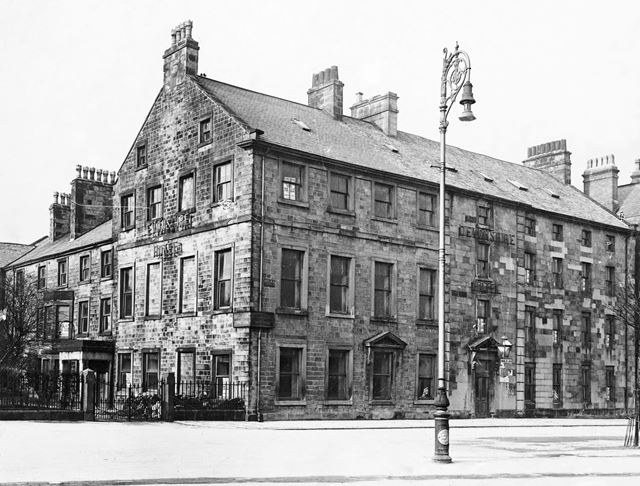
A History of the Eagle Hotel, Buxton

The recent closure of the Eagle Hotel got us thinking here at Discover Buxton Tours about its long history. Whether aboard the tram, or on one of our special walking tours, All Ale and Higher Buxton, we mention its significance in the heritage of the town.

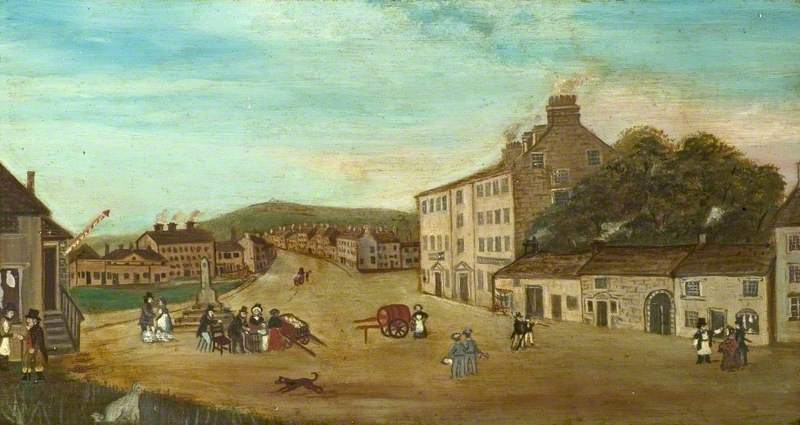
It stands out as a four-storey building, with a later three-storey addition to its south, replacing a coaching inn on the same site called The Eagle & Child, which was first recorded in 1592.

The origin of the pub name ‘Eagle & Child’, however, dates back to the 1300s and there are slightly varied versions of the story but this is the one we like, sourced from Buxton Pubs (2022)[1] with thanks to Julian Cohen.

Buxton Market Place, Derbyshire by Robert Brunt c.1820

The then Earl of Derby, Sir Thomas Latham, desperately wanted a male heir but his wife was getting beyond childbearing years and, so far, had only given birth to a daughter. Unbeknown to his wife, Latham had an illegitimate son by his maid and cooked up a devious plan.

He took his illegitimate son from his maid and hid the baby in an eagle’s nest on his land. Then, when he was out with his wife, Latham arranged for them to discover the child, which he claimed must have been taken by an eagle. Latham persuaded his wife that they should adopt this poor, abandoned child. The crafty Latham now had the son, and potential heir, he had always wanted, without his wife knowing the truth about the baby. The sting in the tale for Latham was that, on his death bed, he repented and told the truth. That meant the adopted boy did not inherit the Latham estate and it went instead to Latham’s daughter, who married Sir John Stanley, uniting the two families under the Stanley name.

People in the area decided to commemorate Latham’s story and his eventual inability to fool his wife by naming a local tavern the Eagle & Child. Following on from what had happened, the Latham family coat of arms depicted an eagle perched on a nest which contains a baby in a basket. This emblem was then adopted by the Stanley family. Rather than just ‘Eagle and Child’, it is also sometimes known as the ‘Bird and Baby’, or, more bluntly, the ‘Buzzard and Bastard’.

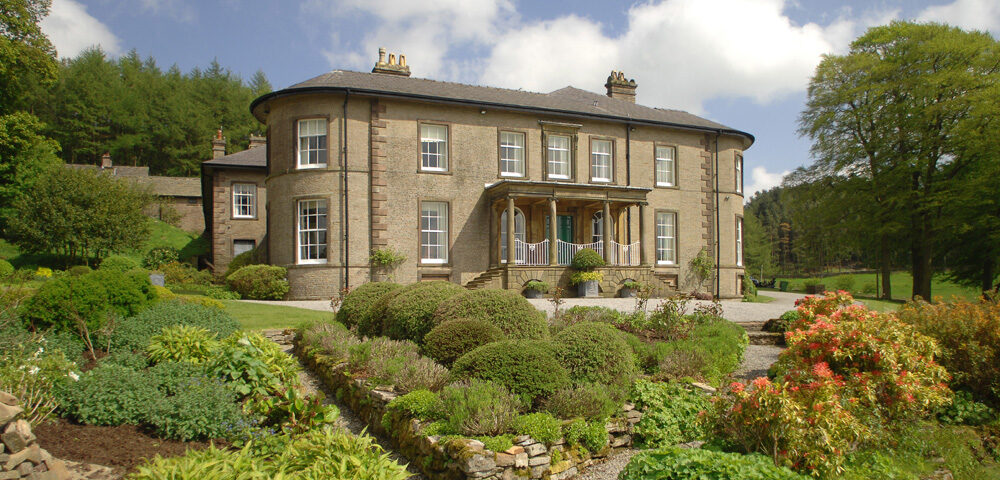
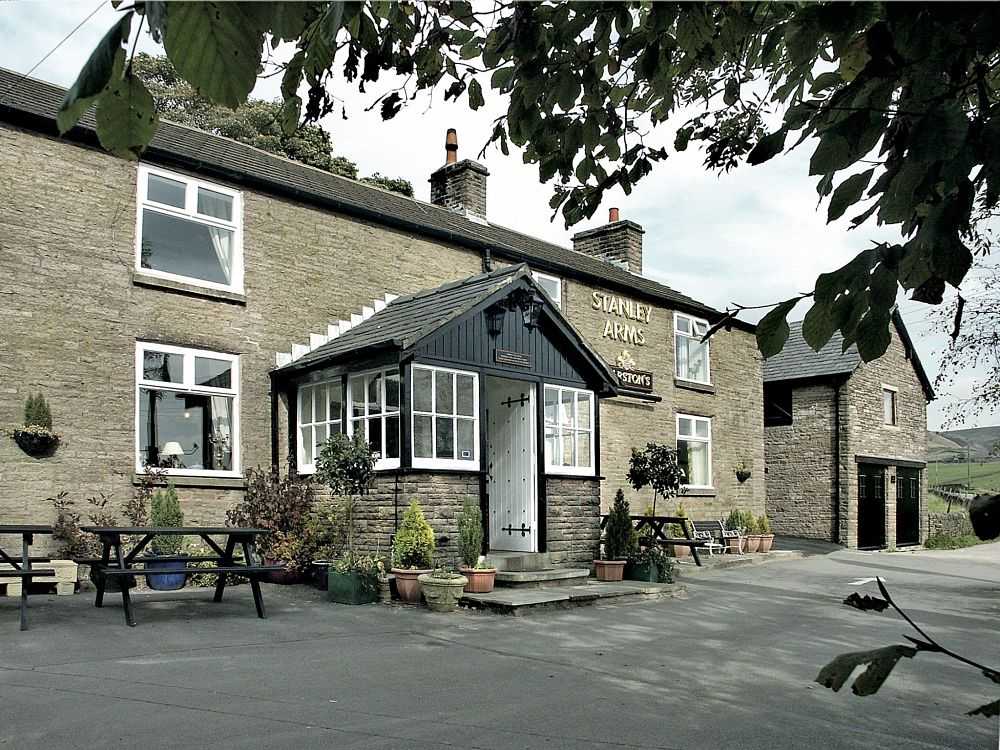
Today, around 700 years later, the Stanley family, The Earl and Countess of Derby, still own vast swathes of land and enormous mansions in various parts of this country. The main family residence is a stately home set amongst 2,500 acres in Knowsley, Merseyside and includes Knowsley Safari Park. Closer to home, the family summer residence has been Crag Hall in Wildboarclough with the nearby pub called the Stanley Arms, named after the family. The Stanleys also have a long connection with the Conservative Party, making large financial donations and being Members of Parliament, one family member even having been Prime Minister. Such uninterrupted power and influence for hundreds of years is very much like our very own Duke of Devonshire and the Cavendish family. As the story of Latham spread across the country, more taverns were named the Eagle & Child. Until recently, there was one in nearby Gradbach but the most famous one is in St. Giles, Oxford. Here J.R.R. Tolkien (author of The Hobbit and The Lord of the Rings) and C.S. Lewis (author of The Lion, the Witch and the Wardrobe) met nearly every Friday between 1939 and 1962 for a drink and a chat.

Crag Hall. Image Source: craghall.co.uk
Stanley Arms. Image Source: stanleyarms.com

Our Eagle & Child was purchased by the 3rd Duke in 1746 and rebuilt in 1760. The buildings behind were stables to serve the inn and these are now the Sainsbury supermarket. Now, if you remember your history, we were having a revolution in France and the fallout of this was that we captured many prisoners of war, one of whom was a French navy Admiral, Francois Joseph Paul, Compte de Grasse, who was held as a prisoner of war by us in London. As he was an aristocrat and all that (Compte meaning he was a Count), it led to him being allowed certain privileges and this included a trip to Buxton! Apparently, when he was here, one of his indulgencies was a visit to the Eagle & Child.

By the late 1790s it began to function as a major coaching inn on the Manchester to London route, providing overnight accommodation, stabling, food and ale. An agreement was made with the rival White Hart Inn, situated opposite on the other side of the Market Place on Scarsdale Place, that passengers travelling south to London used the White Hart and those travelling north to Manchester used the Eagle & Child.

The Post Coach, which set out from the Royal Oak Inn, Manchester, every Tuesday, Thursday, and Saturday mornings, at six o’clock during 1800, would stop to allow passengers to breakfast at what was then the Eagle & Child. Eventually, with the demise of the coaching trade, half of the building became a separate lodging house and by 1820s it was known as The Eagle. During the 1840s, records show that local magistrate courts were held there and later, during the 1860s, the then Duke of Devonshire held annual town meetings at the Eagle with his many Buxton tenants.        

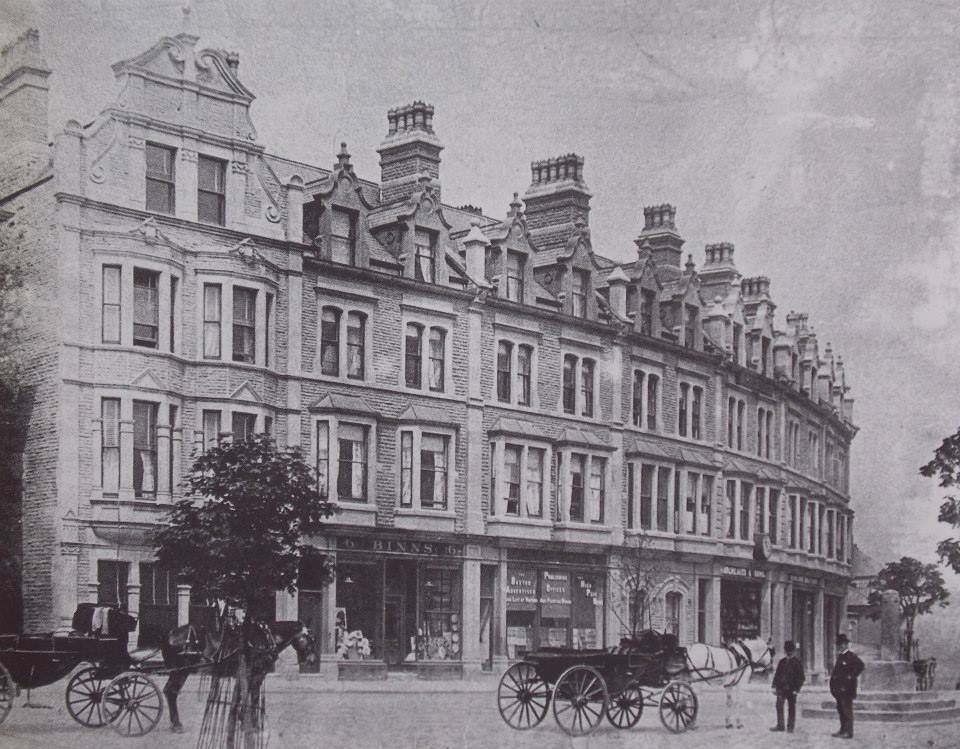
It wasn’t until 1890 that the curved Eagle Parade was added with a block of commercial shops and flats.

In the 1900s, in an attempt to attract a more upmarket clientele, it was renamed the Devonshire Hotel but this failed and it soon reverted back to being called the Eagle.

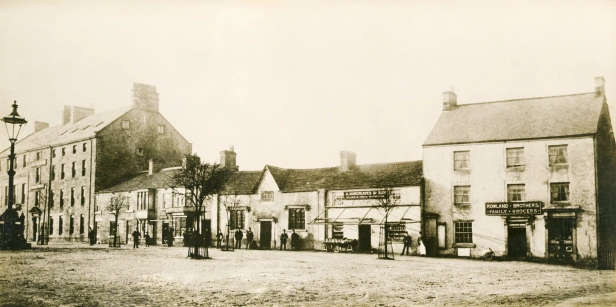
Eagle Parade c.1875
Eagle Parade post-1890
Devonshire Arms c.1900

In 1975, John Craven was shot dead outside on Boxing Day by Brian Hughes with a sawn off, single-barrelled shotgun. Apparently, Craven had grassed up Hughes over a fruit machine job. Hughes freely admitted his crime to the police and spent many years incarcerated at Ranby Prison in Nottinghamshire. Whilst there, he had plenty of time to develop his skills as an artist, including sketching fellow inmates. When he was released from prison in the early 2000’s, he continued to make excellent drawings and paintings until his death.

This rather notorious time continued when a (thankfully) fake grenade was thrown through the window into a full pub.

The Eagle has been owned and run by Hydes Brewery of Manchester (founded 1863) for many years. However, at the end of 2022 they made a decision to sell. The doors remain closed but what a history lies behind.

If you know any more of it, please do get in touch!

NC


[1] Julian Cohen, Buxton Pubs, 2022, Buxton Civic Association